
Executive Impact Series co-authors David Turner and Anush Naghshineh
Introduction: The new normal of overlapping global disruptions
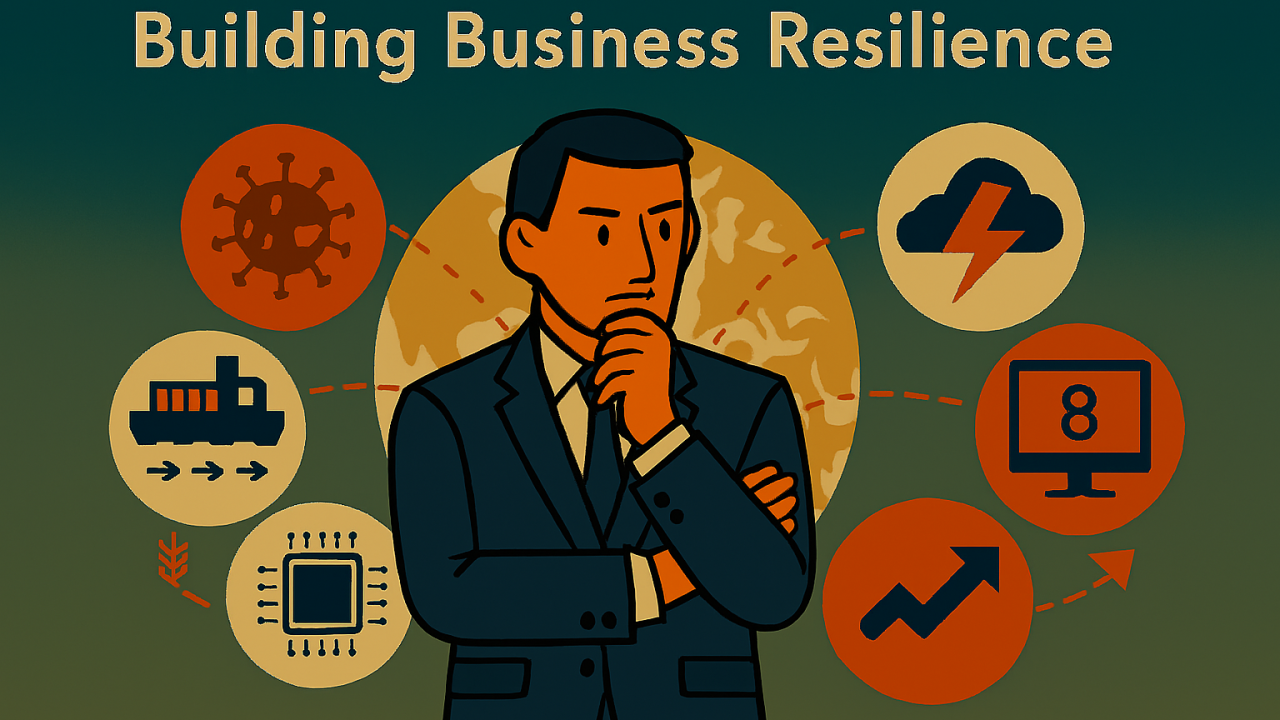
The rules of business continuity have undergone fundamental changes. Organizations now face overlapping and persistent shocks, including pandemics, extreme weather events, supply chain disruptions, inflation, rapid technological advancements, accelerating cyber incidents, and geopolitical instability. These events no longer arrive as isolated outliers; they compound and amplify one another (a supply shortage that fuels inflation, a storm that strains an already understaffed region, or a cyberattack that exploits stretched remote-work controls during a downturn).
Because crises are now the baseline, resilience can’t be a one-off plan or merely a larger cash reserve. It must be embedded across strategy, budgeting, operations, and innovation. That means transitioning from a reactive crisis response to a proactive model that preserves flexibility: identifying critical dependencies, quantifying acceptable risk, and designing flexible, reversible responses that protect core functions while maintaining the capacity to invest and grow, even in volatile conditions.
Financial resilience: Cash flow strategies for uncertainty
The foundation of resilience is liquidity. In an era of persistent shocks, businesses must balance conserving cash with preserving capacity to seize opportunities. Traditional “just in case” stockpiles of cash are insufficient; leaders need dynamic playbooks that can toggle between defense and offense.
Key practices include:
- Scenario-based liquidity planning: Stress-testing against multiple shocks at once (e.g., supply cost spikes and demand dips occurring simultaneously).
- Diversified capital access: Maintaining flexible credit lines, alternative financing relationships, and structured debt that can be reprioritized quickly.
- Cash flow visibility: Leveraging AI-driven forecasting tools for daily, even real-time insights into receivables, payables, and working capital.
- Optionality in cost structures: Using variable cost models (outsourcing, consumption-based IT, contingent labor) to reduce fixed commitments while maintaining execution capacity.
Financial resilience isn’t about hoarding, it’s about precision: knowing where every dollar is working hardest and being able to pivot resources toward stability or growth on demand.
Operational resilience: Creating redundancy without sacrificing efficiency
Global supply chains, once optimized solely for efficiency, now demand a different equation: resilience plus efficiency. Redundancy is no longer “waste, it is insurance. The challenge is to design redundancy smartly, without undermining competitiveness.
Leading practices include:
- Dual-sourcing and nearshoring: Avoiding overreliance on single geographies or suppliers, even if costs are marginally higher.
- Micro-supply chain visibility: Using IoT and advanced analytics to monitor upstream supplier health, logistics choke points, and early warning signals of disruption.
- Adaptive production models: Building modular production capabilities and flexible manufacturing contracts that allow rapid scaling up or down.
- Resilient logistics: Establishing regional distribution hubs, backup transport modes, and digitally orchestrated rerouting to bypass bottlenecks.
Operational resilience reframes efficiency: the most “efficient” system today is not the leanest, but the one that continues to deliver under stress.
Digital resilience: Cybersecurity as a competitive advantage
In the corporate mindset, cybersecurity has moved from simply risk mitigation to a core business strategy. In research surveys, organizations cite investment in cybersecurity as a key competitive capability. With 57% of respondents citing customer trust, and 49% citing brand integrity and loyalty as primary drivers for such investments.
The global cybersecurity market is projected to grow from around $218 billion in 2025 to over $560 billion by 2032, with a CAGR of 14.4%. This growth is being driven by the increasing threats that enterprises are facing, with 55% reporting a rise in cyberattacks this year.
Cybersecurity companies exhibit higher multiples, primarily because they tend to operate with higher efficiency and also grow rapidly. Unfortunately, only 2% of companies surveyed have implemented cyber resilience across their organization, even as almost two-thirds of tech leaders rank cyber as their top risk. The gap between awareness and action is costing companies real money, with the average cost of a data breach across all respondents exceeding $3 million.
Current threats, fueled by AI, highlight an urgent need for organizations to integrate cybersecurity into their product development, customer acquisition, and strategic planning. Companies that do this are more agile, and their customers and partners trust them to handle sensitive information responsibly.
People resilience: Supporting workforce adaptability and wellbeing
Employee well-being has evolved from a nice-to-have perk into a core business capability. More than 20% of employees are experiencing some form of burnout, making them three times more likely to quit than their peers. With talent shortages affecting most industries, losing people to preventable burnout is a luxury companies can’t afford.
Supporting employees to develop their resilience and adaptability has a positive ROI for companies. Resilience enables people to perceive change as either a challenge or an opportunity, constructively regulate their thoughts and emotions, leverage prior experiences, and effectively execute change. At its core, adaptability is the ability to approach uncertainty with an open, constructive mindset and to be both creative and flexible when problems arise. Companies that build both capabilities see tangible results in productivity and successful outcomes. In an era where change is constant, having a workforce that can adapt quickly and recover from setbacks isn’t just valuable, it’s essential for survival.
Many workers increasingly live with fragile and stressed health, with rising costs exacerbating access and affordability challenges. Leading companies are investing in comprehensive approaches that address health and support (mental and physical), flexible work arrangements, and continuous learning opportunities.
Companies are recognizing the connection between physical and mental health strategies to combat stress, burnout, and cognitive decline, especially with an aging workforce. As a result, companies are looking to neuroscience insights to help them design work environments, processes, and schedules that align with natural rhythms. They are fundamentally designing work itself to be more human-friendly.
Conclusion: Integrated resilience framework that preserves growth capacity
In today’s climate of relentless disruption, resilience can no longer be siloed as a one-off initiative or relegated to risk management. It must be embedded into the very fabric of how an organization operates, evolves, and grows. Financial, operational, digital, and human resilience are not isolated disciplines; they are interdependent capabilities that amplify one another. Liquidity strategies falter without operational continuity. Cybersecurity investments ring hollow if the workforce is disengaged. Adaptive supply chains offer a slight advantage without the capital to act decisively.
Resilience, when treated as an integrated framework rather than a checklist, enables leaders to anticipate shocks, navigate ambiguity, and safeguard both performance and reputation. The organizations that will thrive in the era of persistent crises are those that treat resilience not as a defensive reflex but as a strategic asset. When companies incorporate flexibility, redundancy, cybersecurity, and employee well-being into their systems, they can transform disruption into progress, rather than merely surviving volatility. The new normal demands more than survival. This approach involves planning for flexibility, maintaining focus on key priorities, and acting quickly when opportunities arise.