Introduction: The Widening Disconnect Between Available Talent and Needed Skills
Executive Impact Series contributors Anush Naghshineh, and David Turner.
Imagine hearing that the job you’ve done for years is suddenly no longer needed, while billboards all over town advertise thousands of “urgent” openings you don’t quite qualify for. That is the real experience for millions of Americans today.
- Payrolls increased by only 73,000 in July, and revisions wiped out 258,000 spring hires, signaling a cooling labor market even before any recession talk.
- Unemployment increased to 4.2%, with 1.8 million people unemployed for 27 weeks or longer.
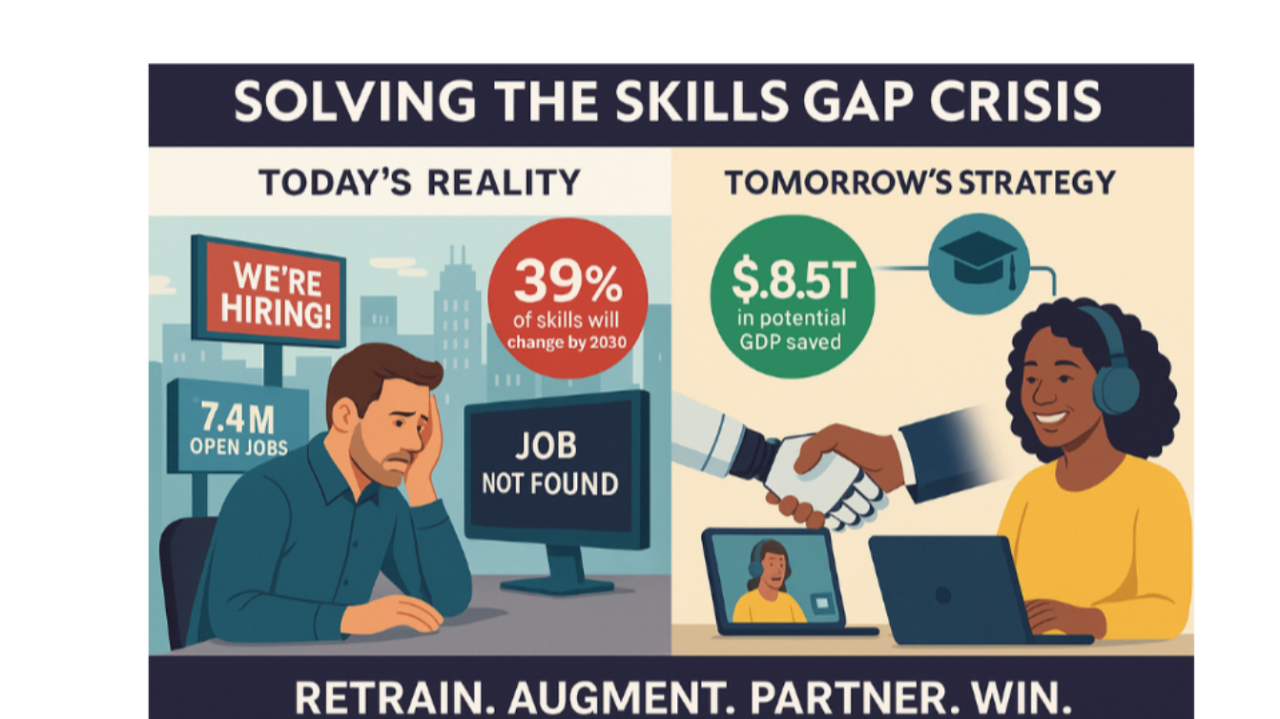
- Yet employers still posted 7.4 million vacancies in June, slightly fewer than May’s 7.7 million.
Behind every statistic is a worker whose skills no longer match the roles available and a manager whose projects stall due to a lack of talent. Employers predict that 39% of core skills will change by 2030, and 76% of tech leaders already feel a significant gap within their teams.
Unless businesses act quickly to retrain the willing, recruit the specialized, and enhance with technology, the country could lose $8.5 trillion in potential GDP. The good news: we have clear, proven strategies to close the gap while getting sidelined Americans back to work.
Industry Impact Assessment: Sectors Most Vulnerable to Skills Shortages
The skills gap crisis isn’t hitting all industries equally. Some sectors are being impacted much more than others, and the sectors most impacted face significant challenges in closing the gap.
Financial services and tech companies are experiencing the most significant skills shortages, with over 75% of financial services leaders and 73% of tech leaders reporting critical gaps in their organizations. Within these industries, 87% of executives and managers say their organizations either face skill gaps already or expect them to develop within the next five years.
Manufacturing is also dealing with serious gaps. The sector currently has about 600,000 job openings, with projections showing 3.8 million more positions needed by 2033. Compounding the shortfall, even with higher wages being offered, one-third of manufacturing workers are actively looking for new jobs.
The cybersecurity field is an example of an extreme situation. Nearly all education sector respondents (96%) reported security team skills gaps, followed by 94% in construction and healthcare, and 93% in real estate. Globally, cybersecurity employs more than 5.5 million people, reflecting 9% growth since 2022, but still faces a gap of more than 4 million open roles.
Healthcare organizations face unique challenges because they need people who understand both technology and strict compliance requirements. Healthcare security teams require expertise in a wide range of industry-specific systems, both old and new, which makes it even harder to find qualified professionals.
The financial impact of long-term skills gaps is staggering. If companies don’t act quickly, the skills gap could lead to $8.5 trillion in lost annual revenues by 2030. That number represents real projects that won’t get finished, innovations that won’t happen, and growth opportunities that companies will miss.
Build Vs. Buy: Creating Internal Upskilling Pathways Vs. External Recruitment
Companies today must make a strategic decision whether to develop talent internally or hire from the outside. The data strongly suggests that building from within is the smart business move.
Studies show companies can save 70-92% on average when they upskill existing employees rather than hiring new ones. Research from ILX Group demonstrates these substantial savings when organizations choose an internal development path. When you factor in recruitment fees (typically 15% of salary), onboarding costs, welcome bonuses for new hires, and performance risks, the savings add up fast.
Another benefit is that companies that emphasize employee development yield 218% higher income per employee, and 94% of employees report that they would stay with their company if it made investments in their career development. To highlight this employee preference, 74% of Millennials and Gen Z workers quit jobs that don’t offer upskilling and development opportunities.
HR leaders at top companies are focusing on developing their workforces. According to recent surveys, HR leaders are planning on using upskilling (75%) and reskilling (62%) in the next year to address company skills gaps, with hiring full-time talent coming in third. Over 63% of leaders say that upskilling is their top priority for solving their company’s skills gaps.
The “build vs. buy” employee debate isn’t about choosing one or the other anymore. Companies increasingly recognize that re-focusing on internal upskilling and reskilling can help overcome the challenges posed by the current labor market. It is more cost-effective, more engaging, and has a greater effect on retention.
The most significant challenge some organizations face is speed. Many companies struggle to upskill and reskill employees quickly enough for them to transition into their next role within the company. However, companies that figure this out will have a major advantage over competitors who keep relying on expensive external hiring.
Education Partnerships: Collaborative Approaches to Pipeline Development
One approach to addressing the skills gap is through partnerships between industry and education. Various organizations work with educational institutions to develop programs, credentials, and experiential pathways that go beyond traditional recruiting efforts. For example, Siemens and IBM offer programs that combine classroom instruction with paid apprenticeships, while Amazon collaborates with community colleges to provide training in cloud computing and logistics. Initiatives such as Georgia Tech’s industry boards and Purdue’s EPICS program connect students to real-world projects and cooperative rotations, aiming to align graduate skills with employer needs.
Successful partnerships typically involve strategic planning, shared governance, and a long-term approach. Educational institutions benefit from industry partners who contribute insights into evolving technologies and skill requirements, not just financial support. Companies are expected to dedicate time and resources, co-develop educational content, and participate in feedback systems that facilitate program updates. Effective collaborations may also include employer involvement in student assessments, project work, and developing pathways from coursework to employment, which helps keep academic programs aligned with workforce needs.
Technology Augmentation: Using Technology to Extend Existing Talent Capacity
Organizations are increasingly utilizing technology, including Robotic Process Automation (RPA), machine learning (ML), artificial intelligence (AI), and active learning (AL) systems, as tools to enhance workforce capacity. RPA addresses repetitive, rules-based tasks such as invoice reconciliation and data aggregation. ML models identify patterns, anomalies, and predictive insights that would otherwise require teams to spend more time uncovering. AI-enabled assistants contribute to code generation, summarization, and decision support, allowing employees to focus on different aspects of their roles. Active learning incorporates human feedback to refine models continuously, adapting automation and improving accuracy over time. This multi-layered approach reallocates worker attention to areas like strategic analysis, creative problem-solving, and stakeholder engagement, while also facilitating ongoing development through real-time interaction with intelligent systems.
The distinction between tooling and augmentation lies in designing for human–machine collaboration. Organizations implementing this approach may restructure roles, focus on change management and upskilling, and form teams where technology handles scale, pattern recognition, and routine tasks. At the same time, humans oversee context, quality, and complex decision-making. These teams review and adjust model outputs, utilize emotional intelligence, and make informed decisions that extend beyond machine capabilities. By formalizing collaboration between humans and machines, companies can address capacity limitations and further develop workforce skills, supporting more effective contributions from existing staff.
Conclusion: Integrated Talent Strategy for Sustainable Competitive Advantage
1. Retrain – quickly by establishing ten to twelve-week academies that guide displaced workers into shortage roles; monitor time-to-productivity. Recruit surgically to fill ultra-specialized gaps with contract-to-hire or project talent, then transfer know-how in-house.
2. Augment wisely – deploy AI/RPA where scaling matters; redirect the hours saved toward strategy and innovation.
3. Partner closely – co-develop curricula with colleges and nonprofits to keep pipelines active.
Companies that weave these levers together will shorten vacancy cycles, future-proof their skills mix, and seize growth that their slower rivals leave behind.