
This Executive Impact series article is a collaborative partnership with Jenny Tsao, Anush Naghshineh David Turner as we examine global business imperatives and explore ways to drive awareness.
The shifting customer experience landscape
In today’s hyper-connected world, customer experience (CX) has become a key differentiator for brands across industries. Expectations are rising rapidly, driven by on-demand digital platforms, personalized recommendations, and real-time support. At the center of this evolution is artificial intelligence (AI), which is transforming how companies engage with customers at every touchpoint. From virtual assistants and predictive analytics to intelligent routing and sentiment detection, AI promises faster, smarter, and more scalable interactions.
Yet, as automation grows, so does the risk of losing the human element that builds trust and loyalty. Customers don’t just want efficient service; they want to feel heard, understood, and valued.
How many of us have initiated an online chat with a virtual agent, only to get quickly frustrated and type frantically, “Agent”?
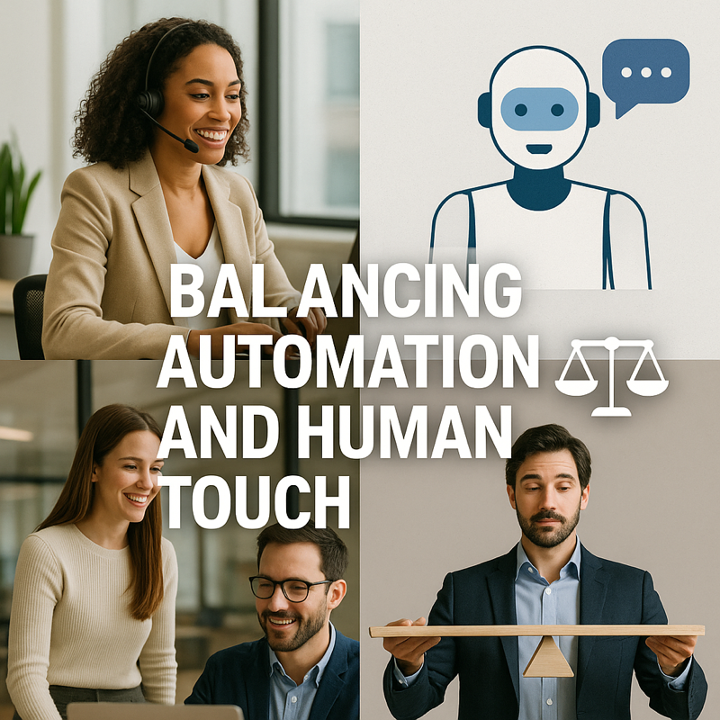
The challenge for modern businesses isn’t choosing between AI and human interaction it’s mastering the art of combining them effectively. This article examines how organizations can strike a balance between technology and empathy to deliver seamless, satisfying experiences at scale. This segment of the industry is ripe for true business transformation, which includes the integration of real-time human-AI agents.
The automation opportunity: Where AI is transforming customer interactions
Companies are using AI extensively to reshape their interactions with customers. AI is creating unprecedented opportunities for automation and efficiency, as well as managing change at a rapid pace. Approximately 85% of customer interactions are being handled by chatbots, reducing the need for human intervention in many routine cases. This shift is allowing businesses to redirect valuable human resources from repetitive tasks to more complex, high-value customer engagements.
The most significant transformations are happening in several key areas. Natural Language Processing (NLP) has enabled AI systems to understand the nuances of human language, including intent, sentiment, and context, empowering chatbots to engage in natural, human-like conversations.
Companies like Walmart have embraced this technology, reducing customer service calls by over 38% while enhancing satisfaction through faster responses.
Lumen, a telecommunications company, now uses Microsoft Copilot to summarize past sales interactions and generate insights about customer needs, business challenges, and industry trends. This process traditionally took up to four hours per seller but has been cut to just 15 minutes, projecting annual time savings worth $50 million.
Meanwhile, Telkomsel’s implementation of a virtual assistant resulted in self-service interactions jumping from 19% to 45%, reducing daily call volume from 8,000 to 1,000.
Fashion retailer Motel Rocks uses AI to automatically classify incoming messages based on customer intent and emotional tone, enabling agents to grasp situations and prioritize responses efficiently and quickly. This kind of intelligent triage is transforming how businesses allocate resources and respond to customer needs in real time.
AI allows companies to manage customer experience and personalization at scale.
The human element: Touchpoints where personal connection matters most
Despite the rapid advancement of AI, it’s people who are irreplaceable in delivering good customer experiences. Customers continue to crave authentic and personal connections that automation cannot provide. While automation offers convenience and efficiency, it would be a mistake to rely on it to handle all customer communication. People fundamentally want to connect with human representatives who demonstrate genuine empathy and care.
The balance between technology and human touch is particularly crucial at specific touchpoints along the customer journey. Companies like Pantheon Tickets use AI to streamline ticketing and provide travel content, but they also ensure their team remains available for personal consultations, offering “that irreplaceable human connection.” As they note, “the key to success will be in harmoniously blending technology with the irreplaceable human element.”
Research from Kantar’s Connect database shows that human touchpoints, such as personal contact with staff and recommendations from friends or independent consultants, collectively account for 20% of the overall brand impact. This human element is especially important during times of uncertainty, as it helps build trust and demystify complicated products.
High-touch customer service, which prioritizes personalized human interactions, remains a potent differentiator in a world dominated by bots and algorithms. While technology is crucial for streamlining operations, it should never become a barrier that prevents customers from reaching live agents. Instead, the most successful companies use AI to enhance human capabilities rather than replace them. They ensure that complex issues, emotional situations, and high-value interactions benefit from the empathy, creativity, and critical thinking that only humans can provide. The future of customer experience isn’t about choosing between AI and human service. It’s about thoughtfully designing where each adds the most value.
Common pitfalls: Where companies get the human-AI balance wrong
In the pursuit of efficiency and scale, many organizations over-automate customer interactions, mistakenly more automation automatically leads to better service. This often results in rigid chatbot scripts, impersonal communications, and frustrating user journeys that alienate customers rather than engage them. A common pitfall is failing to distinguish between transactions that benefit from speed and automation, such as password resets or order status checks, and those that require empathy, judgment, or nuanced understanding. When companies rely too heavily on AI in sensitive or complex service scenarios, the result can be a degraded customer experience that erodes trust and loyalty.
Another critical misstep is implementing AI without properly integrating it into the broader customer experience strategy. Businesses may deploy automation tools without aligning them with customer expectations or training human agents to complement these tools effectively. This leads to fragmented handoffs between AI and humans, with customers forced to repeat information or endure long wait times after automated systems fail to resolve their issues. Successful companies strike a balance by using AI to augment, not replace, human services, ensuring that automation handles routine tasks. At the same time, people focus on delivering empathy, context, and problem-solving where it matters most.
Finding the right balance: Creating a seamless hybrid CX model
Creating a seamless hybrid customer experience requires a thoughtful design that leverages both AI capabilities and human expertise. The most successful organizations strategically determine which interactions benefit from automation and which require human involvement by mapping customer journeys to identify critical “moments of truth“. High-stakes interactions that significantly impact loyalty. This strategic allocation not only improves efficiency but enhances overall satisfaction by ensuring customers receive the appropriate level of attention for their specific needs.
The key to seamless integration lies in creating transparent transitions between automated systems and human agents, with handoffs that include all relevant context and history. Organizations that excel at this balance maintain clear escalation pathways, continuously refine their AI capabilities based on customer feedback, and invest in training human agents to work effectively alongside automated systems. The goal isn’t to minimize human interaction but to maximize its impact – preserving empathy and creativity while allowing technology to handle repetitive tasks and data processing at scale.
Getting started: Practical steps to evolve your CX strategy
Audit your current CX journey: Map out key touchpoints and identify where automation can add speed vs. where human interaction is essential.
Segment customer intents: Use AI to classify service types (e.g., transactional vs. emotional) and direct them accordingly.
Invest in agent enablement tools: Equip human agents with AI-powered insights, history summaries, and real-time guidance.
Design seamless handoffs: Ensure AI systems transfer full context to human agents to avoid customer frustration.
Test and iterate with customer feedback: Use CSAT, NPS, and direct feedback to continuously refine your human-AI model.
Conclusion
Customer expectations are evolving, and so must our strategies to meet them. AI presents a powerful opportunity to enhance efficiency, reduce costs, and improve service availability. But without the human touch, it risks becoming just another faceless technology. The future of CX is not about man versus machine. It’s about partnership.
By harmonizing the strengths of both AI and human agents, companies can deliver personalized, empathetic, and scalable experiences that delight customers and build long-term loyalty. In the age of AI, the brands that thrive will be those that remember what truly matters: people.